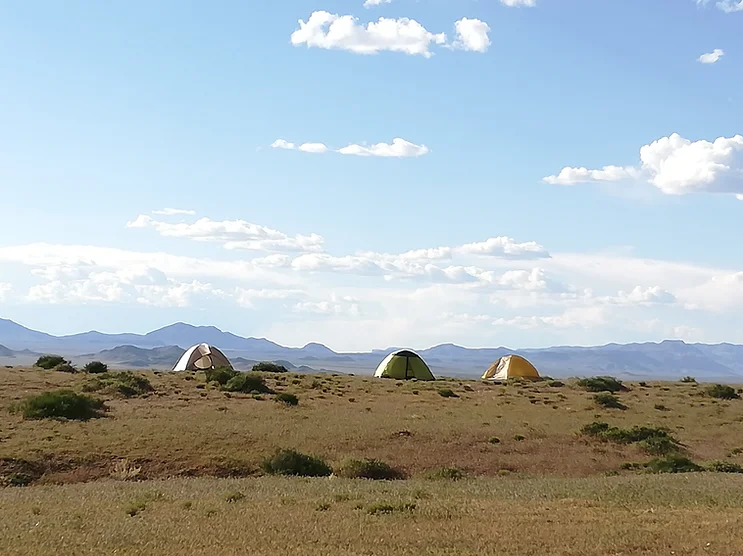
Last week, I had the opportunity to visit Ratón, New Mexico.
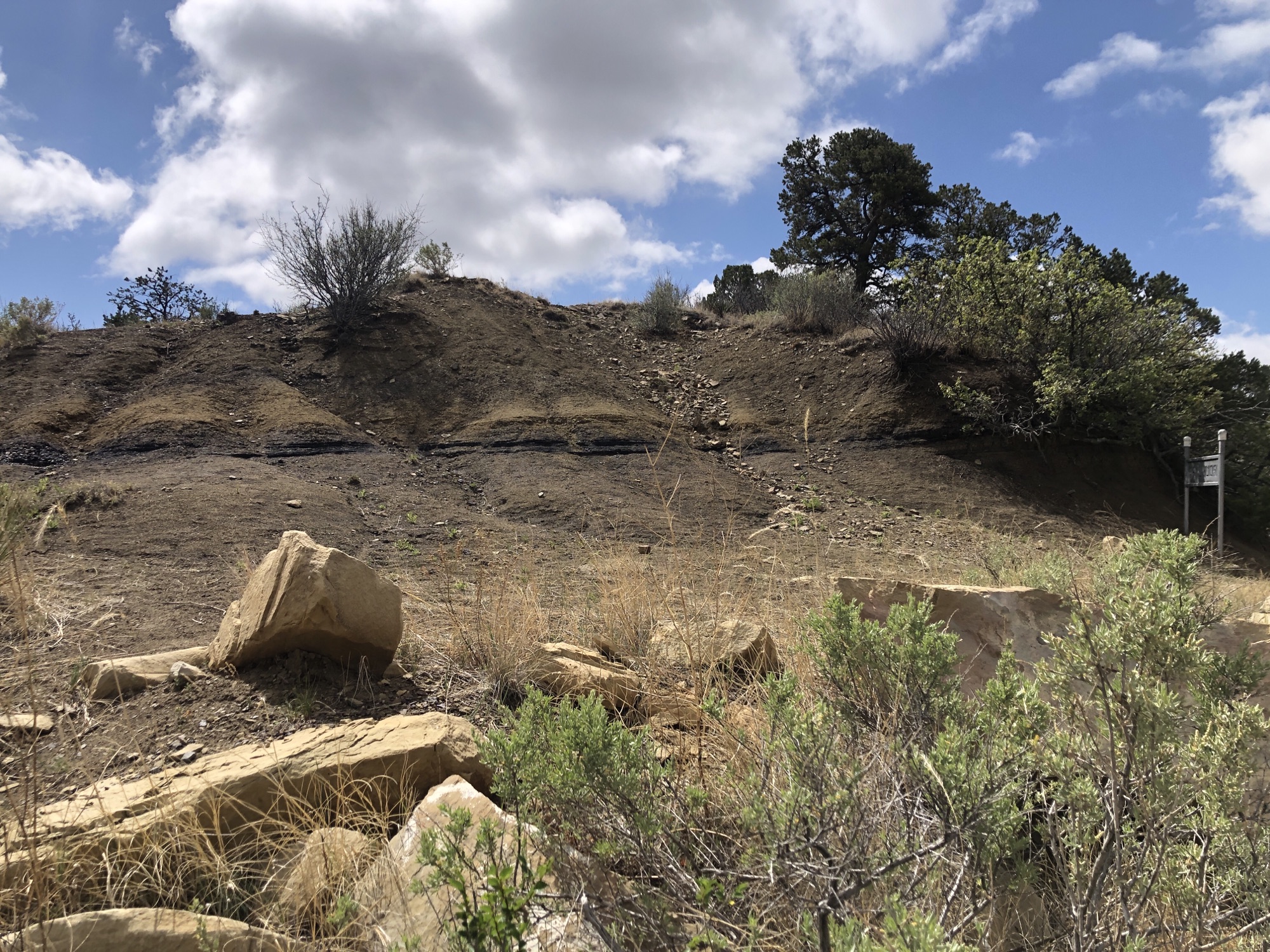
With the end of spring around the corner, I decided check out the K-Pg boundary as this particular area has an iridium anomaly likely from a meteorite. I haven’t been to a spot with a visible K-Pg boundary in a long time (it was called the K-T boundary the last time I saw it), so this was the perfect opportunity to see a really cool geologic feature on a work trip.
Now, you might ask “Why does a plant scientist care about rocks?”.
While plants have my heart, I think the better question to ask would be “Why wouldn’t a plant scientist care about rocks?”.
In the most comprehensive view of the Earth, plants are a microscopic portion of the matter that exists. Plants live on the Earth’s crust and if you work with plants, knowing soils, geology and hydrology is incredibly helpful–especially in desert ecosystems where plant life is defined by adaptiveness and success in “difficult” soils.
In this region of the K-Pg boundary, there are lots of cool fossils that are part of the evolutionary history of plants. And the K-Pg boundary marks a mass extinction event that completely upended life on Earth, including plant life (but mostly animal life).
Within that mass extinction, plants are also (part of) the reason we have coal and petroleum. Fungi didn’t exist yet to break down lignin, a structural material that makes up plants. The lignin and other organic matter from plants was compressed over eons and eventually became a layer of carbon-dense rock that we use for energy.
The other reason I care about rocks is a bit more personal: I think geology is super cool. I come from a long line of folks who dug in rocks for a living (mining) and I grew up rockhounding in the Great Basin desert as a kid. In undergrad, I learned about interdisciplinary work and dipped my toes into hydrology (and was a co-author on a couple of papers).
Unfortunately, the photo above doesn’t show the iridium layer too well as the most visible portion is alongside the road. I got a little too excited and forgot to take a photo from a better angle. The best place to see the iridium layer is where the silver sign is on the right. However, the overall soil layers on this side were more visible (including a dense layer of coal). For y’all it’s a sneak peak into a very unusual formation that you should go see in person.
The driving route was closed to the general public, so I ended up going for a short hike on the volunteer-made trail that featured old-growth juniper and pinyon. I did a counter-clockwise loop with the K-Pg boundary spur, about 3 miles total.
I’ll share a bit more about the old-growth trees I met next week as they deserve their own post.
For me, this was a great way to begin the summer with the solstice, Juneteenth and Pride in only a few weeks. Consider taking some time outdoors this week to enjoy the changes in the seasons.
Tree New Mexico’s Tree Steward Program
Applications are open until August 1st, 2026. Tree Stewards is a statewide urban forestry training & education program covering popular topics, lessons, field trips, plantings (and more!) with guidance and training from various experts for 14 weeks. I supported this program last year as a mentor, lab leader and recently assisted with curriculum review. I highly recommend it if you’re wanting to assist with tree plantings as a volunteer, are seeking foundational training in tree work, or want to learn more about trees. If you are considering a career in arboriculture and live in New Mexico, this program is perfect for you too.
I am scheduling consultations for June-September 2026.
I’ll be in Utah (Utah County) in late August and Central Texas (Waco & College Station) in mid-late September.
Support a local, queer-owned business by requesting an appointment today.
Not quite ready to make a commitment? Consider answering our Ecosystem Manager Questionnaire to outline your goals and explore your relationship to your landscape.
There is one live webinar CEU opportunity this week.
Thursday, June 4, 2026
Novel wilt in Sassafras @ 9:00 am-10:00am Mountain
Sassafras wilt is an emerging threat to sassafras populations in the central hardwood region. Beginning in 2019, localized sassafras wilt was observed in southern Indiana. Symptoms initially raised concern that laurel wilt disease had expanded into the region. However, neither the causal agent (Harringtonia lauricola, previously Raffaelea lauricola) nor its primary vector (Xyleborus glabratus) have been recovered from affected trees in the state. Instead, a novel Ophiostoma sp. and other non-native ambrosia beetles have been recovered from symptomatic trees. Our study aimed to characterize the novel fungus and evaluate its pathogenicity to sassafras. Our results show that the recovered isolates belong to a novel species of Ophiostoma, referred to here as Ophiostoma lauricola sp. nov and that it is capable pathogen of sassafras. These results demonstrate that O. lauricola is a pathogenic fungus of sassafras. While the precise cause(s) of wilting sassafras trees in southern Indiana has yet to be determined, the ability of O.lauricola to cause disease symptoms on inoculated seedlings suggest that it may be involved and a likely contributor to causing this emerging wilt, although additional abiotic factors (e.g., drought stress) may influence wilt development.
On-Demand CEUs
Arbsession Training Videos
Forestry Webinars
The Webinar Portal, a product of Southern Regional Extension Forestry (SREF) and winner of the 2011 USDA Forest Service’s Two Chiefs’ Partnership Award, is a “multi discipline” web platform used to promote and deliver live and on-demand virtual events and webinars focused on forestry, agriculture, conservation, climate science and other natural resource disciplines.
TreeStuff Webinars on YouTube
Watch a video and pass the quiz to qualify for free ISA CEUs.
Tree Care Industry Association (TCIA)
Introduction to Arboriculture Safety (1.25 ISA CEUs)
In this program, you will learn about general tree care safety so that you can avoid accidents while working in the field.
Susan Harwood Grant program OSHA Trainings (Up to 5 ISA CEUs)
Remember, you can always ask your local ISA chapter if your event qualifies for CEUs.
If your organization is hosting a free in-person or virtual ISA CEU opportunity, please reach out to so we can share it!
Subscribe to continue to receive free notifications for no-cost ISA CEU events.