
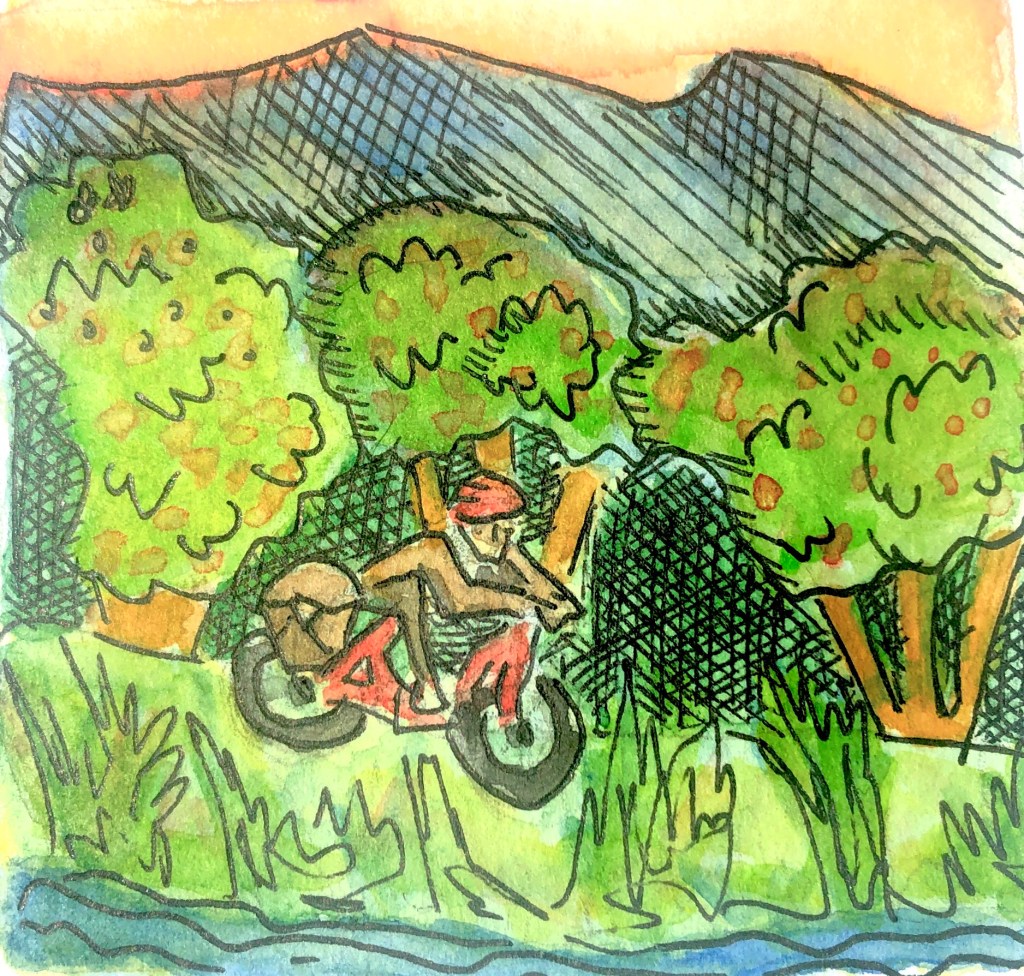
In honor of National Bike month, we’re exploring the impacts of cycling on urban forests.
On a personal level, I am an avid cyclist. It was my main form of transportation until I bought my first car around 23. Before that, I walked, took the bus, rode my bike and got rides with friends. It was a bit easier back when UTA had expanded routes, but due to lack of accessibility, it limited the opportunities for my education and career.
On a professional level, I advocate for the reduction of car dependency in our communities on multiple levels. This tends to be a controversial take since most of the United States lacks comprehensive alternatives for personal vehicles.
Let’s examine how bicycles positively impact urban forests:
What are the main contributing factors to urban tree decline in communities?
Most certified arborists, tree workers, tree surgeons and other folks in the industry would widely agree that the leading causes of tree mortality are related to:
- watering: drought and/or over-watering, depending on local climate and soils
- poor site selection, preparation, planting and establishment which leads to soil compaction and root damage
- overall environmental stress: pollution, urban heat and increased storm runoff due to impermeable surfaces
The Arbor Day Foundation has a great phrase that we all love to use: “Right Tree, Right Place, Right Reason”. It’s a great reminder to keep in mind the leading causes of preventable tree mortality in communities.
How do urban forests influence public health outcomes related to car pollution?
I like to think of trees as oases in communities. They provide innumerable ecosystem benefits, or ‘ecosystem jobs’ in our neighborhoods: shade, cooling, water purification, water percolation, erosion reduction, biodiversity hubs, habitat for wildlife, food, etc. These benefits begin to decline when trees are exposed to environmental stressors like poor water quality, car pollution and root compaction.
Cars produce various kinds of pollution: noise, particulate matter, volatile organic compounds, nitrous oxides, carbon monoxide, sulfur dioxide and carbon dioxide.
Unfortunately, urban trees aren’t as ubiquitous in every neighborhood as one might hope. In communities that have been denied environmental justice, they are disproportionately affected by pollution and lack of green spaces, including vehicular emissions.
Tree planting projects and other forms of achieving canopy equity used the Climate and Economic Justice Screening Tool to identify communities which would benefit from federal and state funding in urban forestry. CEJST was removed by the current administration, but the dataset is still available through Harvard Law School.
If trees and other plants aren’t able to sequester pollution due to the intensity and density, then it directly affects our health.
Trees and forests are especially well-known for their ability to sequester carbon and biodiversity in forests leads to more robust survival outcomes in relation to climate change effects.
In urban forestry, we call this the 10-20-30 (or Santamour) rule: No more than 10% of the same species, no more than 20% of the same genus and no more than 30% of the same family.
To summarize, the more plants we install with different ecological ‘jobs’, the more we can reduce negative health impacts in our communities. In general, native plants are our best opportunity to ensure biodiversity in urban environments.
To learn more about biodiversity, check out ‘Why Biodiversity Matters in Urban Forests’.
In what ways do alternative forms of transportation reduce human causes of environmental stress on trees?
By walking, biking or even carpooling, you are reducing the amount of carbon dioxide that you are producing as an individual. It won’t offset industry or billionaire waste, but it will help you and your local community with overall positive health effects.
During the early days of the pandemic, there was a reduction of greenhouse gas emissions. While greenhouse gas emissions have returned and exceeded previous levels, there is evidence that community-led action leads to better public health outcomes.
Why Bicycles? (sourced from https://www.peopleforbikes.org/statistics/environmental)
If 20% of short car trips were replaced by bicycle trips in Milwaukee and Madison, Wisconsin, it would prevent 57,405 tons of carbon dioxide from being emitted, a value of $1.2 million. Grabow, M., et al., 2010 – Valuing Bicycling’s Economic and Health Impacts in Wisconsin, January 2010
When car travel restrictions reduced morning traffic by 23% during the 1996 Olympics in Atlanta, ozone concentrations decreased 28% and acute care visits for asthma decreased 41%. Friedman, M., et al., 2001 – Impact of Changes in Transportation and Commuting Behaviors During the 1996 Summer Olympic Games in Atlanta on Air Quality and Childhood Asthma, Journal of the American Medical Association, 285(7):897
A San Francisco Bay Area study found that increasing biking and walking from 4 to 24 minutes a day on average would reduce cardiovascular disease and diabetes by 14% and decrease GHGE by 14%. Maizlish, N. et al 2012 – Health Cobenefits and Transportation-Related Reduction in Greenhouse Gas Emissions in the San Francisco Bay Area
When the complete life cycle of the following modes are taken into account, the carbon emissions are approximately: Bicycle, 21 g CO2/passenger/km traveled Electric-assist bicycle, 22 g CO2/passenger/km traveled Passenger car, 271 g CO2/passenger/km traveled Bus, 101 CO2/passenger/km traveled. European Cyclists’ Federation, 2011 – Cycle more often 2 cool down the planet: Quantifying CO2 savings of cycling
A recent study of Barcelona’s bike sharing program, Bicing, found that the health benefits of using the system outweigh the risks by a ratio of 77 to one. The study also estimated that Bicing reduces carbon dioxide emissions by more than 9,000 metric tons every year. Rojas-Rueda, D., et al., 2011 – The health risks and benefits of cycling in urban environments compared with car use: health impact assessment study, BMJ 2011;343:d4521
There are 800 million car parking spaces in the U.S., totaling 160 billion square feet of concrete and asphalt. The environmental impact of all car parking spaces adds 10 percent to the CO2 emissions of the average automobile. Chester, M., et al., 2010 – Parking infrastructure: energy, emissions, and automobile life-cycle environmental accounting, Environmental Research Letters, 5
The air quality improvement and reduced greenhouse gas emissions due to bicycling in Wisconsin is worth more than $90 million every year. Grabow, M., et al., 2010 – Valuing Bicycling’s Economic and Health Impacts in Wisconsin, January 2010
If 20% of Madison, Wisconsin commuters biked to work, it would save 16,687 tons of carbon dioxide emissions, a value of $366,577. If 20% of Milwaukee commuters biked to work, it would save 40,718 tons of carbon dioxide emissions, a value of $821,282. Grabow, M., et al., 2010 – Valuing Bicycling’s Economic and Health Impacts in Wisconsin, January 2010
Bicycle traffic in Copenhagen prevents 90,000 tons of CO2 from being emitted annually. City of Copenhagen, 2010 – Bicycle Account, 2010
More CO2 is emitted by the United States’ transportation sector than any other nation’s entire economy, except for China. Greene, D., and Schafer, A., 2003 – in Pedroso, M., 2008, Safe Routes to School: Steps to a Greener Future
If 5% of New Yorkers commuting by private car or taxi switched to biking to work, they could save 150 million pounds of CO2 emissions per year, equivalent to the amount reduced by planting a forest 1.3 times the size of Manhattan. Transportation Alternatives, 2008 – Rolling Carbon: Greenhouse Gas Emissions from Commuting in New York City
Half of U.S. schoolchildren are dropped off at school in the family car. If 20% of those living within two miles of school were to bike or walk instead, it would save 4.3 million miles of driving per day. Over a year, that saved driving would prevent 356,000 tons of CO2 and 21,500 tons of other pollutants from being emitted. Pedroso, M., 2008 – Safe Routes to School: Steps to a Greener Future
What activities can you do to celebrate National Bicycle Month ?
Register & Vote in local elections.
Reduce your car use through carpooling, walking, cycling, etc.
Continue to use the Climate and Economic Justice Screening Tool
Take Free ISA CEU courses to learn more about tree care.
Support awareness efforts like Healthy Trees, Healthy Lives.
Take a free Tree Board University course
Get involved with your local Municipal Tree Board.
Volunteer in a tree planting, neighborhood cleanup or celebration.
Instead of driving, try to ride, walk, take the bus, or carpool.
Learn about native plants around you and teach others.
Book a Forest & Nature Therapy walk to unwind.
Read a book by Dr. Robin Wall Kimmerer, an Indigenous botanist.
Explore some current conversations in urbanism


 Abbott Botanical Assessments, LLC