Tag: plants

  • Why Teach Your Children About Plants?

    Why Teach Your Children About Plants?

    So they will never be lost and their teachers are always remembered.

    The opportunity to cherish plants and share that joy with others is becoming increasingly rare in formal and informal educational spaces. I was lucky enough that my then-rural Utah high school offered CTE classes, Agricultural Science classes, AP science classes and a Zoology/Botany class. That is changing as fewer classes nationally and worldwide focus on plants. My alma mater, Utah Valley University, is one of the few universities in the US that educates future botanists.

    Knowing and ‘seeing’ plants has saved my life, metaphorically and literally, more than once. Without plant knowledge, my safety would have been at risk. Through plants, we can know where to find water, food, shelter, emotional and spiritual safety. This takes many forms, but building relationships with plants leads to a greater understanding of the world around us. When you take the time to see and recognize the smallest members of life, you begin to appreciate the world differently.

    Taking the time to teach the children in your life about plants develops their senses and builds a life-long thirst for knowledge that can’t be quenched. You can start by telling your child a story about some of the plants in your community:

    • Who planted the tulips on your street?
    • Why did your grandma plant that tree?
    • Who taught you how to garden?
    • Why did your relatives always keep sagebrush on the dashboard of their cars?
    • What is your favorite plant (flower, tree, etc) and why?
    • Did you ever go to a community tree planting? What was that like?
    • What smells from plants feel like home to you?
    • What does that plant feel like?
    • What happens when you touch that plant’s flowers?

    I love a story, so I’ll tell you a few of mine.

    I have moved so many times in my life that I’ve lost count of the homes I’ve had, but I’ve always had plants to provide insight into where I was, where I am going, what time of year I was in and build relationships around me.

    In each place I’ve lived, I had friends parents, ‘adoptive’ and biological relatives and many other community members have deep care for my well-being. All had one thing in common: they taught me about plants. It was rarely formal; it was usually going for a walk on the way to the library, church or an event. Or for the sake of getting fresh air.

    When I was around 8, one of my friend’s parent’s taught me how to harvest berries in Nussloch: “The ones low to the ground are for the foxes and the tallest ones are for the birds. We can eat the ones in the middle, but we need to take only the smallest amount we need so other people can eat them too.”

    Blackberry photo sourced from https://www.fassadengruen.de/en/blackberry.html

    When I was a toddler, my paternal grandmother, Barbara, shared her love of roses with me and my mother. It was a source of joy for their relationship. My grandmother taught me the parts of the roses before we moved away, ‘Here’s the petal, here’s the thorns, when you miss me take a big whiff of one and know I’ll be with you.’ I still take big whiffs of roses any time I see one.

    She got me into community plantings. I can’t remember if it was when I was in Germany or Spanish Fork, but we had a small flat of purple pansies to plant and I didn’t know how to. She showed me how to break apart the roots so that they could thrive and not keep growing in a circle. After the planting, every time we walked by, I could see the ones we planted because they were brighter than the rest. She loved blackberry shakes from Barry’s, an alligator jaw or a bearclaw, and a Pepsi.

    Morgan's paternal grandmother wearing all black and looking like a badass.
    My paternal grandmother dressed up in leather and black cowboy hat in Spanish Fork, Utah.

    My Ma Jewel and Opa were outdoorsy people and taught generations of our family how to ‘be’ outdoors. I met them in person when I was around 13 after moving back to Utah. They had a beautiful yard filled with fruit trees and vegetables as their landscaping. I remember feeling at home because I recognized the rhubarb in their yard. I hadn’t seen it since I moved away from Germany a few years earlier.

    Ma Jewel & Opa

    Their son, Paul, is my maternal grandfather. He taught me how to love the desert and to how find water by following the cottonwoods. He told me about Big Tree, a national champion white fir, up Loafer Canyon, “Get up there to visit before you get too big to put your arms around it.”

    Papa at Big Tree up Loafer Canyon.

    I got to visit Big Tree in high school as a field trip in one of my science classes before it died in the Pole Creek Fire. One of my favorite traditions that I learned from my science teacher was to eat sardines when you climb a mountain or visit a big tree.

    One of my paternal aunts had my botany undergraduate professor as a public school teacher and was thrilled to find out I was also taught by her during my studies.

    There are many, many people who have taught me. Some I haven’t mentioned to maintain their privacy, others I may not remember or know their names, but they gave me a rich gift of knowing plants and providing the tools for me to teach others.

  • Abbottanical Native Wildflower Seeds

    Abbottanical Native Wildflower Seeds

    Originally published in September 2021 and re-published on May 2, 2025.

    After starting this business in 2019, I desperately wanted to provide a product that was missing from the market in the Intermountain West: a locally-sourced, 100% native wildflower seed mix.

    Many of the wildflower seed mixes that are commercially available in nurseries and grocery stores are labeled as native, but have non-native or even invasive species to cut the mix to bring down costs. Cynoglossum amabile, Chinese forget-me-not, is a wildflower that is native to central Asia and is regularly used in pollinator mixes. While it is beautiful, it does tend to escape from gardens and becomes a persistent weed in the community. Additionally, pollinators visit this flower, but a native Utah bee wouldn’t have a symbiotic relationship to a flower that originates on the other side of the world. Consider an alternative: a native forget-me-not that has evolved within ecological communities within Utah, like Hackelia micanthra, meadow forget-me-not, or Eritrichium nanum, arctic alpine forget-me-not.

    Unfortunately, it is difficult to source native seeds, especially in Utah where wild native plants have a reputation of being “weeds” or are considered “ugly” in comparison to showy cultivars that are widely available in large nurseries. That being said, I was able to come up with a seed mix that features showy native wildflowers that are a proven hit with pollinators and “poor” soil that is prevalent in Utah.

    I feel that these wildflowers represent the best parts of Utah: resilience, beauty and hope for a brighter future. I consider all of them my friends that cheer me up during my long weeks in the field under the hot summer sun. As this mix has a variety of annuals and perennials, you will find that some of these friends won’t make a dramatic appearance for a couple of years. I have a 3 tips to help the wait feel a bit shorter:

    #1. Be patient: long-lasting relationships that are healing our environment takes time.

    #2. Be on the lookout for introduced species that can be used at home for food or herbal remedies. Finding plants that settler ancestors brought that have crowded out their neighbors, limited traditional food & medicine pathways and reduced pollinators is one way to support indigenous sovereignty within our communities. I always recommend utilizing safety protocols to eliminate spread.

    #3. Be Mindful: It is the perfect time to practice relationships (plant identification & learning plant ecology) with your annual wildflowers and other plants that already exist within your community.

    These are the 10 wildflowers that made the cut for “Abbottanical Native Wildflower Seeds” Mix:

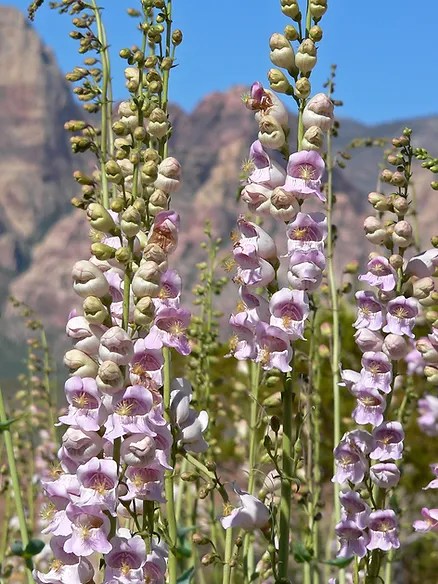
    Penstemon palmeri (Palmer’s penstemon) is a perennial light-pink snapdragon look-alike that is widespread in Utah between 3,000 and 8,000 ft. Peak flowering times occur in late-April through mid-June. It is also one of the few penstemon that have a scent.

    Photo courtesy of Stan Shebs via Wikimedia Commons.

    Distribution Map

    Linium lewisii (Blue Flax) is a showy blue perennial that is native to North America and can be found along roadsides and washes. This plant can be used as fiber and is a popular favorite for pollinators. Peak flowering time is from early-May to mid-July between 2,000 and 10,000 feet. It loves full-sun and birds love to snack on its seeds through fall and winter.

    Photo courtesy of Skoch3 via Wikimedia Commons.

    Distribution Map

    Cleome serrulata (Rocky Mountain Beeplant, waa’, tumi, a’pilalu & ado:we) is a prolific native wildflower in North America. An annual with vivid pink or creamy white blossoms, it has numerous ethnobotanical uses and attracts innumerable pollinators. It flowers between late-July and early-September at elevations between 2,000 and 8,000 feet.

    Photo courtesy of Clarence A. Rechenthin via Wikimedia Commons.

    Distribution Map

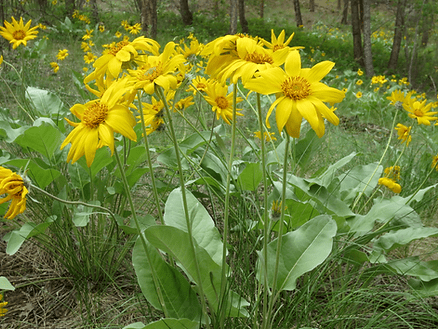
    Balsamorhiza sagittata (Arrowleaf Balsamroot) is a large yellow flower and a member of the sunflower family found in western North America. Perennial and full of ethnobotanical uses, it attracts native pollinators to your garden. Flowering between mid-May through June and thrives in elevations up to 8,000 feet.

    Photo courtesy of Extemporalist via Wikimedia Commons.

    Distribution Map

    Gaillardia aristata (Common Blanketflower), a perennial native wildflower that has multiple ethnobotanical uses. Usually found in seed mixes as a cultivar, but is locally-sourced seed in our mix that grows wild in fields and meadows within the Intermountain West. Flowers from June to July up to 8,000 feet.

    Photo courtesy of Walter Sigmund via Wikimedia Commons.

    Distribution Map

    Echinacea purpurea (Purple Coneflower), this is a popular perennial medicinal wildflower that is native to the central United States and is found within Colorado’s native range. As it isn’t strictly a Utah native plant, I debated adding it to the seed mix. However, its popularity and showiness as a native North American plant is tremendous. It is easily recognizable and heavily attracts native pollinators. I’m in the works on sourcing seeds from it’s closely-related cousin Rudbeckia occidentalis (western coneflower) that is a native Utah wildflower for next season’s seed mix.

    Photo courtesy of Eric Hunt via Wikimedia Commons.

    Distribution Map

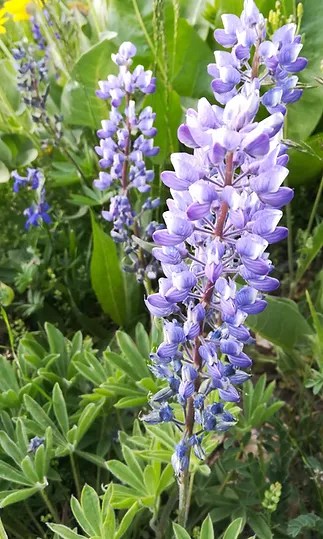
    Lupinus argenteus (Silvery Lupine) is a stunning perennial wildflower that grows across North America, including Utah. Despite its beauty, it is the only plant in this mix that isn’t safe for consumption. It is safe to touch, but don’t let children, livestock or pets consume it. If you don’t want it in your garden, it is very easy to identify and remove before it becomes established. Flowering occurs during the summer (June through August) and thrives at elevations between 4,000 and 10,000 feet.

    Photo courtesy of Morgan S. Abbott, Abbott Botanical Assessments.

    Distribution Map

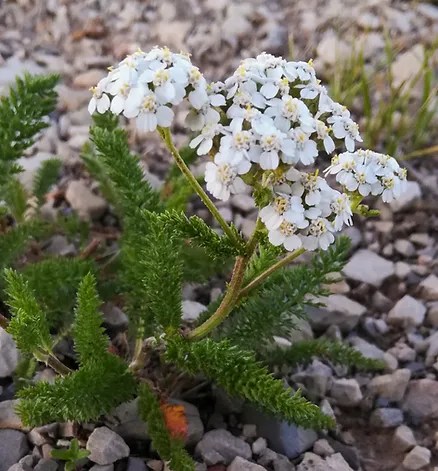
    Achillea millefollium (Yarrow) is a common wildflower that is extremely prevalent throughout North America and is starting to be incorporated into lawns and neighborhood gardens. Yarrow blooms from late-March into early-August, especially at lower elevations (0-2,000 feet). At higher elevations (4,000-10,000 ft), yarrow has a shorter blooming period, from mid-June to the end of August. This wildflower is considered native, but has been hybridizing with European cultivars for hundreds of years, blurring the line between native and naturalized.

    Photo courtesy of Morgan S. Abbott, Abbott Botanical Assessments.

    Distribution Map

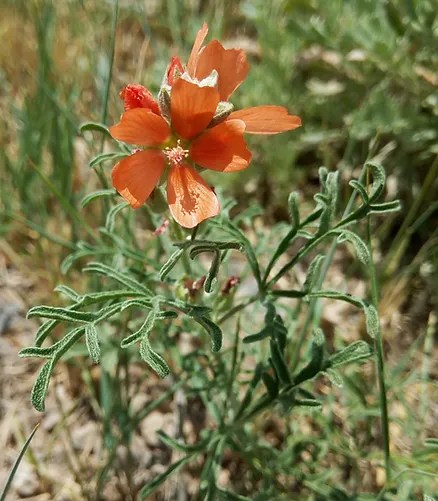
    Sphaeralcea coccinea (Scarlet Globemallow), an ethnobotanical staple in the West, is a personal favorite of mine. It loves to grow in hot, dry places that have high rates of disturbance. Its red-orange blossoms can be found during May and June from 4,000 to 8,000 feet. A perfect wildflower for a south-facing side yard in Utah Valley.

    Photo courtesy of Morgan S. Abbott, Abbott Botanical Assessments

    Distribution Map

    Sphaeralcea parviflora (Smallflower Globemallow) was chosen for this mix because it is so prevalent in the Colorado Plateau and the Mojave Desert ecosystems. I wanted to include a plant that is quintessential to desert life and red rock. Also a dedication to people and places that are dear to me. The bloom time for this wildflower can be seen from late-April to early-July from 4,000 to 8,000 feet in elevation.

    Photo courtesy of Max Licher via SEINet Portal Network.

    Distribution Map

    Propagation of “Abbottanical Native Wildflower Seeds”

    These 5 steps are sourced from this website!

    #1: Planting Time: This means plant right after the first hard frost. The recommended date would be on Halloween (October 31, 2021) if you’re sowing around 4,800 feet.

    #2: Prepare your site. Look for an area that has at least 6 hours of sun per day. Remove weeds and other unwanted materials. Wildflowers need room to grow!

    #3: Sow. You can mix your seeds with sand for even distribution. Make sure to spread the seeds out so that they can thrive and not compete with each other for nutrients.

    #4: Step on the seeds. Gently walk on the area that you sowed seeds. They need sun and will not germinate if they aren’t stratified by cold weather.

    #5: Hurry up and wait. You don’t need to water seeds as they should receive enough precipitation in the winter. Blooms for annuals will appear in spring or early summer.

    Where can I buy your seeds?

    I am no longer carrying or selling this product. If you are interested in sourcing 100% native wildflower seeds please contact your local Utah Native Plant Society chapter, US Forest Service, Bureau of Land Management field office, University with a field botany course (Southern Utah University, Utah Valley University, Weber State, Brigham Young University, Utah State University, etc), or relevant community partners.