Tag: gardening

  • Memorials & Trees

    Memorial Day commemorates the sacrifices of service members. According to the National Cemetery Administration, it began after Major General Logan issued the ‘Memorial Day Act’ in 1866 to remember fallen soldiers after the American Civil War and a day to decorate their memorials with flowers and other mementos.

    However, this day has started including those who haven’t served in the military. Many communities use this day to visit graves of their loved ones.

    Why do we use plants to honor the dead?

    Many plants follow the same seasons, literally and metaphorically, as humans: we’re born, we live, we rest, we may have offspring, we hold roles in our communities, we pass away.

    In the spring, we awake after a long, cold winter. In the summer, we grow–reaching peak fullness in early autumn when we return to deep rest in the winter. While each part of the world varies, we can affirm that this cycle has existed for all life for time immemorial.

    All of our lives are tied to the green world around us. It’s a natural thing to live a life and honor that experience through the beings that are always near us, bringing childlike joy and wonder to everyday living, including the end of our loved ones lives.

    Why are trees so popular as memorials?

    Trees are arguably one, if not the most, ‘charismatic megaflora’ on Earth. In other words, beings that are so impressive to the naked eye that it provokes an emotional reaction; we physically look up to them and frequently care for them as family members.

    Long-lived species like oaks offer a way to commune with our loved ones long after their passing. Trees give protection from harsh rays, cool our homes, live for many human generations, provide food and shelter for innumerable species, serve as a keystone connection to ecological habitat and are a constant physical reminder honoring those that have passed.

    Humans & Trees

    Humans and trees are more alike than folks may realize. While physically, we may differ, we have been in relationship with our tall, woody friends for a very long time.

    One could say that we heal trauma and damage similarly through compartmentalization that occurs faster near new growth, and find resilience in where we are planted.

    All trees may have similar forms and structure (in the sense that they have secondary growth as woody material), but not all species of trees are directly related to each other or even have common ancestors. This is a scientific phenomenon called convergent evolution.

    How incredible is it that that so many different beings that have differ in community roles end up sharing similar traits even though they aren’t ‘actually’ related? It kind of sounds human, doesn’t it?

    How do I choose a tree as a memorial?

    This can be a hard question as it becomes more complicated depending on exactly the answer you’re looking for.

    We can separate the following advice into three different categories for the folks that will be assisting you during this difficult time: your arborist, the funeral director and a spiritual advisor/clergy. All of these experts should be in conversation with each other and your family.

    You can find a Certified Arborist through the Trees Are Good: Find An Arborist search function.

    Your arborist should follow the adage: ‘right tree, right place, right reason, right season’. They will likely ask if you have a species, leaf colors, flowering or anything particular in mind that reminds you of the person you have lost.

    Your arborist should be trained on how to plant a tree properly, keeping in mind the size, location especially in regards to long term maintenance and should communicate this to you. The US Forest Service provides a great manual for tree owners.

    If you’re choosing to inter your relative in a cemetery, talk about tree care and what the tree maintenance schedule looks like with funeral home/cemetery staff. If the trees are not well-maintained, especially over graves and memorials, other important details for your relative’s resting place may be overlooked.

    Both deciduous and evergreen trees are suitable, depending on the story the family is trying to tell. It may be wise to ask if the family wants a tree that ‘follows’ the seasons (in the sense that it goes dormant every year) or one that ‘perpetuates’ all of the seasons (that the tree doesn’t enter dormancy in the winter).

    This phrasing may not work for you, so feel free to explore how to ask these questions with someone that supports the family during difficult times such as clergy or the funeral director.

    Planting saplings can be therapeutic for families that have lost children. As the tree grows and reaches maturity, one can remember that seeds can be shared with friends and relatives to commemorate life events.

    Trees are just as unique as people and have characteristics that shine in different seasons:

    A native redbud (Cercis occidentalis or Cercis canadensis) which blooms in early spring for a loved one that had a birthday during that time or to celebrate new life after a long winter. The heart shaped leaves that exist throughout the growing season evoke a sense of whimsy and have charismatic movement when the wind blows by.

    Perhaps the person who passed away loved water and was creative. If appropriate site conditions exist, a native willow species may be a good option. Many creative opportunities exist with willow, especially within weaving traditions.

    Be open to what moves and inspires you.

    I lost a tree that means a lot to me. What are my options?

    Depending on many factors like the species, health, and existing risk you may be able to support your memorial tree as a ‘snag’.

    ‘Snags’ are trees that have died, but still exist as habitat. They fill ecological roles beyond their natural life. An excellent online resource for your arborist is Cavity Conservation Initiative.

    If the tree is not able to be turned into a snag, you can request to keep burls or other prime pieces of wood for art pieces, furniture, frames for paintings, or other creative expressions.

    If all else, you may be able to request to mulch the tree and keep the mulch for your use. or use for firewood. Please remember to keep felled trees on your property. It helps reduce spread of invasive species & diseases.

    I’d like to celebrate a tree in my life

    Here is a short list of ceremonies to explore. This isn’t a ‘scientific’ list of things you can do to save a tree, but rather a way to come to terms spiritually and emotionally with events that are co-occuring to you and the tree.

    When you plant a tree, consider taking photos. You can write letters to the tree and place them on the branches, or bury them in the soil.

    Commit to watering your newly planted tree on certain days of the week. After establishment, consider doing deep waterings seasonally.

    When you have decided to remove the tree, let the tree know what is happening. Sit with the tree and chat with them. Thank them for anything they’ve helped you with: shade, food, play, etc.

    When decline begins, ask the tree to produce seed so you can propagate its progeny. Some trees will produce vast amounts of seed at the end of its life anyway, but it doesn’t hurt to ask.

    When you’ve removed a tree, consider building a fire with the felled wood. Try writing letters of good memories and place them in the fire. As the smoke reaches into the sky, so will your thanks. The cooled ashes have many uses and can be reused.
  • World Pollinator Day & Urban Ecology

    World Pollinator Day & Urban Ecology

    What is World Pollinator Day?

    World Pollinator Day, or World Bee Day, is an environmental awareness holiday to support the critical role of pollinators in our communities.

    Why should I care about World Pollinator Day?

    As we describe on this blog frequently, all life is connected.

    Angiosperms, or flowering plants, make up about 80% of all life on earth–over 250,000 species. Of these species, a significant portion are food crops and 35% of all food crops are pollinated.

    The health of the environment is directly tied to our health and pollinators. Scientists have specific vocabulary that describes that relationship: indicator species. Indicator species aren’t always pollinators , but can be amphibians, birds and other organisms that show the effects of climate and environmental change so acutely, we can measure their presence to show the impacts of environmental change.

    What are pollinators?

    Pollinators include many kinds of life, not just insects. Birds, bats and some mammals are also pollinators, (including humans). These organisms have a long relationship with flowering plants through a process called co-evolution.

    Why do scientists say that we’re in a mass extinction event?

    If you speak to your parents, grandparents or folks that are older than you, you will likely hear about how much the world has changed since they were you age. This doesn’t necessarily apply to just technology or economic changes, but also includes changes in your environment. You may have also noticed differences in your environment as you have gotten older. I know I have.

    I’m in my early 30s, but I moved around and traveled a lot as a kid. Some of the strongest memories I have were from road trips. Although we lived in a desert climate, there were so many insects all over our car any time we drove more than an hour. This became more pronounced when we moved further east to the other side of the United States and when we moved overseas.

    When I moved back to my hometown in Central Utah in the mid 2000s, there was such a noticeable decrease in insects and birds that my parents were surprised. When I moved to Texas in 2022, I’d be on long roadtrips for work, up to 8 hours of driving through various climates and ecosystems, I’d rarely have any bugs on my front bumper or windshield. This is called the Windshield Phenomenon, a measurable indicator of climate change and ecological health.

    Why is the decrease in insect diversity concerning?

    Insects hold a unique role in ecosystems. When scientists talk about ‘trophic levels’ and ‘food webs’, insects are some of the most important species holding it all together.

    Many insects function as pollinators, which help plant species propagate and create new life. They also function as food for other species and a significant source of protein for larger organisms like birds and amphibians.

    Take a look at this example of a food web from North Carolina State University:

    What are you noticing about this food web?

    What would happen if the plant was removed?

    What effects would occur for the other living organisms that depend on that plant for food?

    This is a very simplified example of what ecologists do on a day to day basis, examining site conditions to determine ecological impacts for various (and frequently innumerable) species. There are specific ways of managing and documenting species that help maintain and encourage ecosystem health for future generations.

    How are urban forests and pollinators connected?

    Urban forests are one of the largest pockets of greenspace in cities that include multiple levels of plant biodiversity.

    Typically, you see a diagram like this (from New York City Parks & Rec Department) when talking about urban forest canopy levels/structure:

    Each of these layers has a role and supports specific ecological niches.

    These plants, ideally, are native species that provide habitat, food and other ecosystem services that support urban biodiversity. Native species have been around for a long time and have developed partnerships with native pollinators for eons.

    However, it is recommended to increase the biodiversity of canopy species to reduce pests and disease, so non-native species are frequently planted to achieve those goals. Additionally, it is hard to find many species of plants in commercially available nurseries as they have specific ways of germinating that impact it’s viability as a commercial product.

    How do I find information about my local pollinators?

    There are so many different resources to learn about your local pollinators.

    Internationally, iNaturalist is one of the best tools available. Data is collected by everyone and confirmed by experts in your community and worldwide. There are apps in all major app stores, a comprehensive website and has worldwide events anyone can participate in. It’s free, supports open-sourced data, and works like a real-life PokeDex.

    In the United States, most land-grant universities have Extension offices. These are community experts that typically specialize in traditional settler agriculture, but are increasingly including experts in native plants, gardening and engaging in community science opportunities and training for laypeople.

    Are domestic bees pollinators?

    Technically, yes.

    However, they aren’t the most efficient pollinators and increase competition for forage among native species. This has wide reaching effects and causes conflict among conservation advocates and community members who are seeking food sovereignty through bee-keeping.

    One way to keep domestic honeybees and support native bees and other pollinators is by building habitat.

    How do I increase pollinator diversity?

    Plant more native species in your area!

  • Responsible Harvesting: A Botanist’s Perspective

    Responsible Harvesting: A Botanist’s Perspective

    Originally published in October 2019 and re-published on May 2, 2025.

    I’ve seen a number of posts on social media talking about wildcrafting and harvesting. I think it is an excellent opportunity to discuss this botanist’s perspective on ethical harvesting. My personal philosophy is simply this: don’t take more than you can use. However, this also means that you should be mindful of the ecosystem that you are harvesting from.

    Here are some key questions you should ask yourself: Does this population have more than 7-10 individuals? Is there another population of this plant nearby? Has this stand already been harvested from?

    When I explain this concept to children, I explain that you shouldn’t eat wild plants unless the following conditions have been met:

    1.) Has Morgan (or another trusted adult) said it is okay to eat this plant?

    2.) What are the ways you can tell this plant is safe to eat (ex. Serviceberry has leaves that look like cat paws, white flowers and/or fruit that looks like blueberries)?

    3.) Why do you want to eat/collect this plant?

    I ask these questions for a number of reasons. Primarily, it builds critical thinking skills while also building good habits about mindful collection and our role in our environment. When answering the third question, it brings to mind your motivations about why you are using this plant. If this is the only plant that you see and it has already been munched on by animals and you have snacks with you, why collect? Animals don’t have grocery stores or kitchens or appliances to store food, while we, as humans, have innumerable tools at our disposal to eat a relatively healthy diet.

    Take Home Points:

    1.) Be confident in your plant identification skills. If you aren’t 100% what this plant is, don’t eat it! Take a photo and post it on a plant ID page on social media (Make sure you include your location, photos of flowers, fruits, leaves and habit!).

    2.) Count out how many individual plants exist in this area. We are looking for at least 7.

    3.) Generally, we shouldn’t collect more than half of what a single plant is producing to make sure that there is enough for animals and the seed bank.

    4.) Consider recording GPS coordinates and collecting a specimen for your local herbarium and iNaturalist. This helps local plant enthusiasts understand the distribution of species in an area!

    Suggested Literature:

    Braiding Sweetgrass: Indigenous Wisdom, Scientific Knowledge, and the Teachings of Plants (Kimmerer, 2013)

    Guidelines for the Ethical and Sustainable Harvesting of Wild Plants (Forest Service, USDA)

    Are you interested in cultivating your botanizing skills, wanting to learn about local plants in your yard, or are wanting me to come assist you in a project?

    Book a free 15 minute consultation!

  • Abbottanical Native Wildflower Seeds

    Abbottanical Native Wildflower Seeds

    Originally published in September 2021 and re-published on May 2, 2025.

    After starting this business in 2019, I desperately wanted to provide a product that was missing from the market in the Intermountain West: a locally-sourced, 100% native wildflower seed mix.

    Many of the wildflower seed mixes that are commercially available in nurseries and grocery stores are labeled as native, but have non-native or even invasive species to cut the mix to bring down costs. Cynoglossum amabile, Chinese forget-me-not, is a wildflower that is native to central Asia and is regularly used in pollinator mixes. While it is beautiful, it does tend to escape from gardens and becomes a persistent weed in the community. Additionally, pollinators visit this flower, but a native Utah bee wouldn’t have a symbiotic relationship to a flower that originates on the other side of the world. Consider an alternative: a native forget-me-not that has evolved within ecological communities within Utah, like Hackelia micanthra, meadow forget-me-not, or Eritrichium nanum, arctic alpine forget-me-not.

    Unfortunately, it is difficult to source native seeds, especially in Utah where wild native plants have a reputation of being “weeds” or are considered “ugly” in comparison to showy cultivars that are widely available in large nurseries. That being said, I was able to come up with a seed mix that features showy native wildflowers that are a proven hit with pollinators and “poor” soil that is prevalent in Utah.

    I feel that these wildflowers represent the best parts of Utah: resilience, beauty and hope for a brighter future. I consider all of them my friends that cheer me up during my long weeks in the field under the hot summer sun. As this mix has a variety of annuals and perennials, you will find that some of these friends won’t make a dramatic appearance for a couple of years. I have a 3 tips to help the wait feel a bit shorter:

    #1. Be patient: long-lasting relationships that are healing our environment takes time.

    #2. Be on the lookout for introduced species that can be used at home for food or herbal remedies. Finding plants that settler ancestors brought that have crowded out their neighbors, limited traditional food & medicine pathways and reduced pollinators is one way to support indigenous sovereignty within our communities. I always recommend utilizing safety protocols to eliminate spread.

    #3. Be Mindful: It is the perfect time to practice relationships (plant identification & learning plant ecology) with your annual wildflowers and other plants that already exist within your community.

    These are the 10 wildflowers that made the cut for “Abbottanical Native Wildflower Seeds” Mix:

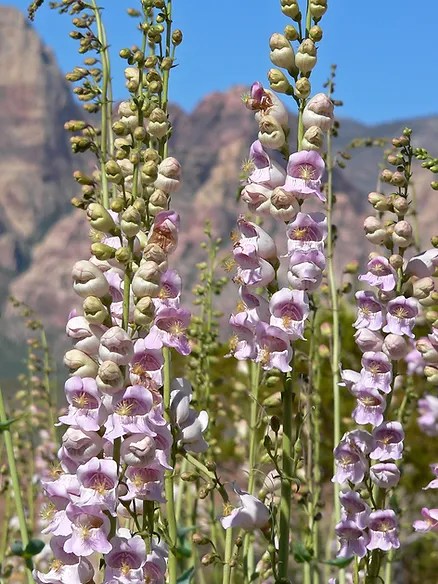
    Penstemon palmeri (Palmer’s penstemon) is a perennial light-pink snapdragon look-alike that is widespread in Utah between 3,000 and 8,000 ft. Peak flowering times occur in late-April through mid-June. It is also one of the few penstemon that have a scent.

    Photo courtesy of Stan Shebs via Wikimedia Commons.

    Distribution Map

    Linium lewisii (Blue Flax) is a showy blue perennial that is native to North America and can be found along roadsides and washes. This plant can be used as fiber and is a popular favorite for pollinators. Peak flowering time is from early-May to mid-July between 2,000 and 10,000 feet. It loves full-sun and birds love to snack on its seeds through fall and winter.

    Photo courtesy of Skoch3 via Wikimedia Commons.

    Distribution Map

    Cleome serrulata (Rocky Mountain Beeplant, waa’, tumi, a’pilalu & ado:we) is a prolific native wildflower in North America. An annual with vivid pink or creamy white blossoms, it has numerous ethnobotanical uses and attracts innumerable pollinators. It flowers between late-July and early-September at elevations between 2,000 and 8,000 feet.

    Photo courtesy of Clarence A. Rechenthin via Wikimedia Commons.

    Distribution Map

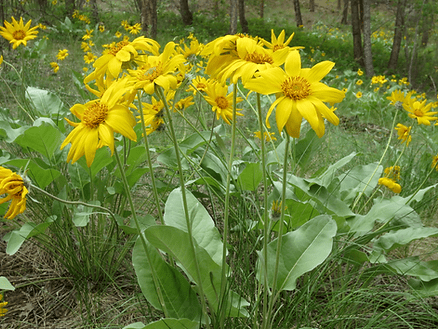
    Balsamorhiza sagittata (Arrowleaf Balsamroot) is a large yellow flower and a member of the sunflower family found in western North America. Perennial and full of ethnobotanical uses, it attracts native pollinators to your garden. Flowering between mid-May through June and thrives in elevations up to 8,000 feet.

    Photo courtesy of Extemporalist via Wikimedia Commons.

    Distribution Map

    Gaillardia aristata (Common Blanketflower), a perennial native wildflower that has multiple ethnobotanical uses. Usually found in seed mixes as a cultivar, but is locally-sourced seed in our mix that grows wild in fields and meadows within the Intermountain West. Flowers from June to July up to 8,000 feet.

    Photo courtesy of Walter Sigmund via Wikimedia Commons.

    Distribution Map

    Echinacea purpurea (Purple Coneflower), this is a popular perennial medicinal wildflower that is native to the central United States and is found within Colorado’s native range. As it isn’t strictly a Utah native plant, I debated adding it to the seed mix. However, its popularity and showiness as a native North American plant is tremendous. It is easily recognizable and heavily attracts native pollinators. I’m in the works on sourcing seeds from it’s closely-related cousin Rudbeckia occidentalis (western coneflower) that is a native Utah wildflower for next season’s seed mix.

    Photo courtesy of Eric Hunt via Wikimedia Commons.

    Distribution Map

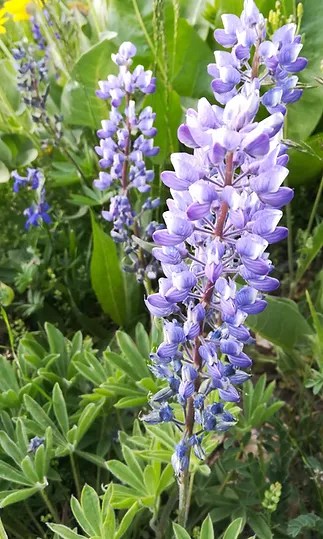
    Lupinus argenteus (Silvery Lupine) is a stunning perennial wildflower that grows across North America, including Utah. Despite its beauty, it is the only plant in this mix that isn’t safe for consumption. It is safe to touch, but don’t let children, livestock or pets consume it. If you don’t want it in your garden, it is very easy to identify and remove before it becomes established. Flowering occurs during the summer (June through August) and thrives at elevations between 4,000 and 10,000 feet.

    Photo courtesy of Morgan S. Abbott, Abbott Botanical Assessments.

    Distribution Map

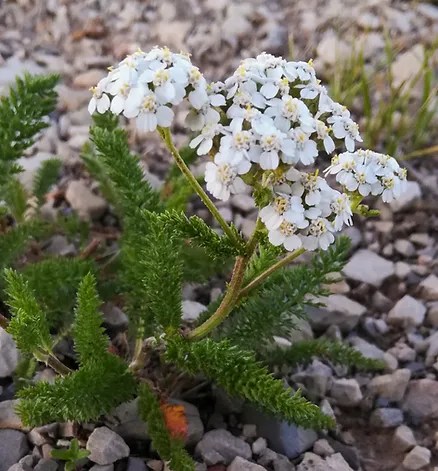
    Achillea millefollium (Yarrow) is a common wildflower that is extremely prevalent throughout North America and is starting to be incorporated into lawns and neighborhood gardens. Yarrow blooms from late-March into early-August, especially at lower elevations (0-2,000 feet). At higher elevations (4,000-10,000 ft), yarrow has a shorter blooming period, from mid-June to the end of August. This wildflower is considered native, but has been hybridizing with European cultivars for hundreds of years, blurring the line between native and naturalized.

    Photo courtesy of Morgan S. Abbott, Abbott Botanical Assessments.

    Distribution Map

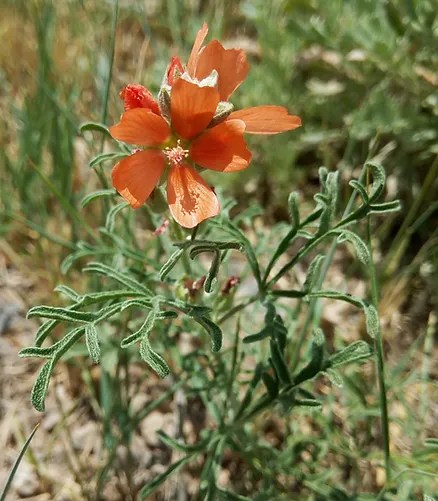
    Sphaeralcea coccinea (Scarlet Globemallow), an ethnobotanical staple in the West, is a personal favorite of mine. It loves to grow in hot, dry places that have high rates of disturbance. Its red-orange blossoms can be found during May and June from 4,000 to 8,000 feet. A perfect wildflower for a south-facing side yard in Utah Valley.

    Photo courtesy of Morgan S. Abbott, Abbott Botanical Assessments

    Distribution Map

    Sphaeralcea parviflora (Smallflower Globemallow) was chosen for this mix because it is so prevalent in the Colorado Plateau and the Mojave Desert ecosystems. I wanted to include a plant that is quintessential to desert life and red rock. Also a dedication to people and places that are dear to me. The bloom time for this wildflower can be seen from late-April to early-July from 4,000 to 8,000 feet in elevation.

    Photo courtesy of Max Licher via SEINet Portal Network.

    Distribution Map

    Propagation of “Abbottanical Native Wildflower Seeds”

    These 5 steps are sourced from this website!

    #1: Planting Time: This means plant right after the first hard frost. The recommended date would be on Halloween (October 31, 2021) if you’re sowing around 4,800 feet.

    #2: Prepare your site. Look for an area that has at least 6 hours of sun per day. Remove weeds and other unwanted materials. Wildflowers need room to grow!

    #3: Sow. You can mix your seeds with sand for even distribution. Make sure to spread the seeds out so that they can thrive and not compete with each other for nutrients.

    #4: Step on the seeds. Gently walk on the area that you sowed seeds. They need sun and will not germinate if they aren’t stratified by cold weather.

    #5: Hurry up and wait. You don’t need to water seeds as they should receive enough precipitation in the winter. Blooms for annuals will appear in spring or early summer.

    Where can I buy your seeds?

    I am no longer carrying or selling this product. If you are interested in sourcing 100% native wildflower seeds please contact your local Utah Native Plant Society chapter, US Forest Service, Bureau of Land Management field office, University with a field botany course (Southern Utah University, Utah Valley University, Weber State, Brigham Young University, Utah State University, etc), or relevant community partners.