
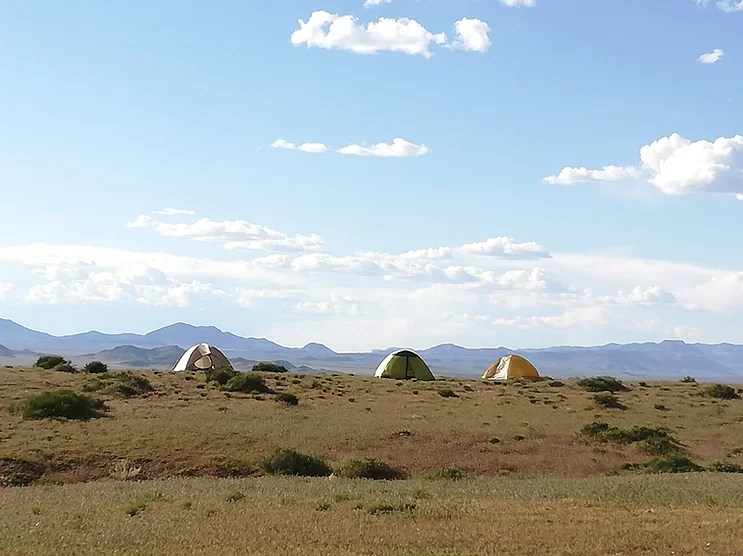
Tag: field-safety

  • 5 C’s of Desert Field work

    5 C’s of Desert Field work

    Published in March 2021, re-published on May 2, 2025.

    Botanical field work in a harsh climate is an endurance sport. It is vitally important to prioritize the care of yourself, your team and your gear. You are a professional athlete existing in one of the world’s extreme environments. However, you aren’t just using your body, you’re also required to apply your education and skills with limited external support aside from your team. Use this guide to limit fatigue, increase preparedness and be mindful of you and your team needs.

    1. Cover

    Cover all of your limbs, especially if you are fair. Wear long sleeves, long pants, a wide brimmed hat, sunscreen on exposed skin and a bandana; your shoes also are included. If you are doing field work that is off the beaten path in rough terrain, do not wear lightweight trail runners. You will get cheatgrass (Bromus tectorum) in them and will cut your feet. I recommend wearing hiking boots that have a higher ankle and have leather uppers. Socks are vital to keep your feet happy and wool has great moisture-wicking properties. Using the right kind of field gear on your body will prevent the formation of injuries and heat-related illnesses.

    To learn more about boots, check out ‘All About Boots: A Botanist’s Perspective’

    2. Cool

    Consider the kind of fabric you are using for your gear. I prefer to wear a cotton or linen ‘overshirt’ to protect my skin and keep cool. However, you need to be careful with chafing, so take frequent breaks and remove your pack to dry out. When I first started out, I would get my field clothes from the thrift store or use hand-me-downs from relatives. Now, I prefer light-colored shirts that have UV protection. Desert nights are very, very cold and the mornings are cool. Bring layers for day and night use. There’s a trend in the outdoor industry to be “ultralight”. You’re probably car camping, so weight isn’t as much of an issue. Bring what you think you will need. You will pare down your field work belongings as the weeks go on.

    3. Coarse

    The desert is a harsh environment, especially if you aren’t used to it. Your hair, skin, eyes, hands and lips will feel it the most because they are continually exposed to the dry air. I recommend finding a hydrating lotion and/or lip balm. If you have long hair, to prevent matting and painful tangles, try oiling your hair with jojoba, coconut oil or conditioner and braiding your hair in a protective style appropriate for your hair texture. Consider getting sunglasses that completely wrap around to protect your eyes from the dust and sunburn. I would skip wearing contacts and get prescription glasses and sunglasses. Getting sand in your contacts can cause corneal abrasion.

    4. Care

    Your physical, emotional and mental health are important to the success of field season. Physical health can include stretching in the morning and evening to avoid injury, inspecting your feet for blisters, splinters or other issues. Remove your boots when you’re able to and wear sandals to let your feet breathe. This includes grooming: if water for bathing isn’t available, use baby wipes, bandanas, drybrush to get all the soil and sweat off of your body.

    Bring food & drinks that you want to eat. This isn’t the time to try a new diet. Your body needs nutrients and you need to eat. Food needs to be shelf stable to avoid food-borne pathogens. Please drink electrolytes to avoid electrolyte depletion. I’m a blue-flavor gatorade gal. Let your crew members and/or crew lead know immediately if you are injured or aren’t feeling well.

    Emotional health can include many things, but we’re going to focus on setting boundaries. You will be working closely with your co-workers for 8-16 weeks. It is likely that you will have disagreements: collection methodology, where to camp, where to gas up, what to listen to in the car, etc. If you feel safe to do so, speak up and communicate your needs. Your employer wants you to complete difficult tasks in a challenging environment. It is more expensive to hire and train a new crew member than to hear your concerns.

    See our Bill of Rights for Natural Resource Professionals.

    Arguably, mental health is the most important factor to keeping your morale up during field season. My go-to for a quick pick-me up on a hard day are sweets. I’m a big fan ginger candies and fancy instant coffee for cold mornings. To build rapport with your crew, bring treats to share (barring food allergies or dietary restrictions). If you need to recharge after a long day, bring activities that you enjoy. I bring books (physical or electronic/audiobooks), a journal/notebook, travel-sized art supplies and my current knitting project.

    5. Chaos

    Something will go wrong during field season, it is just a matter of time. It could be multiple flat tires two hours away from the nearest tire shop, an allergic reaction or injury, or an acute safety incident.

    I’ve found the best way to prepare for these situations is to have a personal first aid kit that holds your medications (OTC and prescribed), eye drops, bandaids, tweezers & needles (for removing splinters), alcohol wipes and anti-bacterial ointment. If you have asthma or severe allergies, inform your team members where your emergency medication is in your pack. Know where the nearest hospital, grocery store (water source), gas station and repair shop are. Be prepared to bail out if you or your team’s safety is comprimised–few jobs are worth not coming home to your loved ones and this isn’t one of them.

    Some days are going to be awful and you will want to quit. If you do, that’s okay. It’s not for everyone and there are even more natural resource jobs in office environments than ever before.

    If you liked this article and want to learn more about Desert Field Skills Training Workshops, book a free 15 minute consultation with us to learn more.
  • All About Boots: A Botanist’s Perspective

    Previously published on 03/07/2021. Revised and updated on 5/2/2025. This post is not sponsored content.

    It is cold and rainy today in Utah. If I have a choice in hiking weather, rainy isn’t usually my favorite. I don’t have a lot of rain gear because we generally don’t get rain. I have exactly one raincoat and no umbrellas. So I feel like today is a great day to talk about a hiker’s most important gear: footwear. I have very strong opinions about footwear because I like having comfortable feet, and I’m really picky. I expect my boots to hold up in dense patches of cheatgrass (Bromus tectorum), hiking up shale, or wading through cow pies and dodging prickly pear cactus (Opuntia polycantha). I also need to be able to use a manual transmission while in the boots.

    Trail Runners vs Hiking/Work Boots

    This is pretty divisive among myself and my colleagues. I think the main differences can be boiled down to what you need. If you need a shoe that is light and breathable trail runners are great for that. Especially if you’re planning on staying on a trail and avoiding pokey plants and cheatgrass. I’m in the camp that prefers boots because I need the support. I have strong ankles, but I like the extra protection, grip and durability of boots. I wore trail runners in the field and was seriously injured because I wasn’t wearing my normal footwear. My foot slipped off a rock and I fell about 8-10 feet on a talus slope. I was fine, just had a concussion and a neck sprain, but if I had my regular boots I wouldn’t have been injured.

    Cost

    To start off with, I think it is worth spending money on your footwear. It is the only thing that protects you from the ground. If you screw up your feet, you won’t be able to hike easily. Don’t be afraid to spend over $100 on boots if you can afford it. I am frugal and I don’t spend money on much besides good boots once a year and knitting materials. I usually spend between $200-300 on boots.

    You can find boots at Walmart for $50-75 that have glued soles and synthetic materials. If you don’t hike for your job and only go hiking a couple of times per year, that’s fine. When you start hitting the $100-150 range, you’re getting into boots that are made to be hiked in regularly. This price range isn’t unreasonable if you’re getting mens’ boots. In my experience, women usually have to spend more to get the same quality of materials as a mens boot. I can’t tell you the amount of times I was really excited to find a really awesome boot for $150, but then saw that it had plastic eyelets that were glued to the leather, whereas the mens boots had metal d-rings that were secured to the uppers with rivets. To get the same quality, I would have had to spend an extra $40 because the mens boots didn’t go down to a small enough size.

    Experience

    Go to a place that does good boot sizing for women with quality shoes. I’ve been to many stores in my area that had a terrible women’s selection and terrible customer service. I’d recommend going to stores that don’t require you to be a walking Patagonia or North Face ad to shop there. Despite women’s sizing issues at Red Wings outlets, I really love the quality of their boots and their customer service. They usually can find small men’s boots to fit women’s feet. I’d also try going to your local gear store. Here where I live, we have Out N Back, who I LOVE. They didn’t have the boots I wanted to try on, but were happy to send me to a store that did.

    How to look for a quality boot

    I prefer boots that are leather. I like the main body of the boot to be leather with a little bit of padding around the ankle for comfort. I like a flexible, but grippy sole.

    1. GLUE: When I’m looking for a new boot, I make sure that there isn’t any glue leaking where the uppers meet the sole. You also don’t want any gaps. It should be pretty smooth. I feel that it shows that the manufacturer is detail-oriented. If there is glue all over, then what other defects exist?
    2. LONGEVITY: I like boots that can be resoled–I don’t own a pair like that right now, but if you don’t wear out uppers before your sole wears out, you are a good candidate for resoling. It saves you money, saves it from landfills and saves you time breaking in new boots.
    3. EYELETS/GROMMETS: Make sure the eyelets (where the laces go through) are metal and are securely attached to the boot. If you have plastic eyelets they will fall off and this can put you at risk for injury. You don’t want to trip on a bootlace while you’re rock scrambling.
    4. SOLES: Do the soles fall apart if you aggressively rub them in your hands? If they do, don’t buy them.
    5. INSERTS: Can you put in an insert? They can help with supporting your arches and encouraging proper spine alignment, while increasing the longevity of your boot. Very important if you have high/low arches and are on your feet all day.

    Trying them on

    Wear or bring socks that you are planning on using with these boots. When you put on your boots, notice where it is rubbing. If it’s an all-leather boot like the Red Wing 606 you can expect to be a little tight for the first two weeks or so. It’s because you have to break them in so the leather can form to your feet. It should be a little tight, but it will stretch out the more you wear them, especially if you regularly oil them. Walk in the boots you’re trying on. Run, squat, twist, go on your tiptoes. Do normal movements that you do every day at work. If they hurt your feet, talk to the salesperson. They’re there to help you find the perfect boot for your needs. If you know the kind of boots you want, try and find last seasons colors and styles for a discounted price. Usually there aren’t any defects and you can get a quality women’s boot at a very affordable price.

    What I Wear

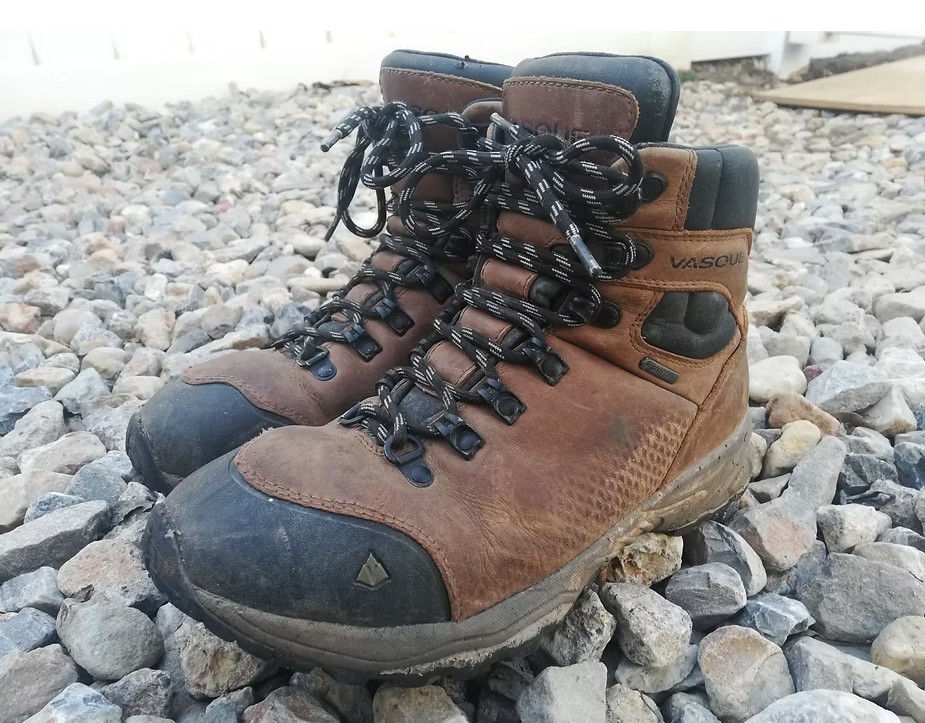
    I’ve owned many pairs of boots in my life and my favorite boots so far are Vasque St. Elias Women’s Boot . I was boot-hunting for a few weeks in March 2019 and I was getting really frustrated trying to find a boot that fit my feet and would at least last me through the field season (Mid April-September). I wanted something that had metal eyelets that were secured to the uppers. Since March 2019, I’d estimate that I’ve put over 200 miles on this pair. I spent the spring and summer on the border between Nevada and Utah with highs ranging from 32F to 110F. They have survived a very unusual wet spring and summer. Post-field season uses, I have used them as regular cold weather boots while shoveling snow and going on walks in the park. I’ve also gone snow-shoeing in them and I was pleasantly surprised that they held up and kept my feet warm.

    Keeping your boots in tip-top shape

    1. Moisturize the leather on your boots, especially if you live in a dry climate like I do. It keeps the leather from cracking and breaking and increases the life of your boot.
    2. Don’t wear them constantly. Your feet need to air out at the end of the day. Make sure to bring camping shoes with you like a pair of old slippers or sandals. It gives the leather time to breathe and let your boot (and feet) air out. If you’re traveling between areas, take off your shoes and socks and let them breathe.
    3. Clean your boots after each use. I wipe my boots down with a damp bandana if there is a fine layer of dust. If they’re damp from scat or mud, I wipe off as much as I can from the uppers and the soles and use a dry brush to finish cleaning the dried dirt until I get back home. I don’t soak my boots to wash them as that can damage the leather, glue and metal.
    4. Clean your feet! If you’re out in the field, make sure to wipe down your feet with a wet cloth or baby wipes. This helps prevent your feet from getting cuts, heat rashes blisters and body odor.
    5. Always bring more socks. On my 8-day trips last season, I brought twice as many socks than I needed. Wear wool socks if you aren’t allergic. It wicks away moisture and keeps foot-funk down because of antimicrobial properties. This also helps you avoid sweat buildup in your boots.
    6. Consider using a wool insole. If you’re needing extra support a wool insole is a good option. They help your feet stay dry, don’t contribute to microplastic pollution and are biodegradable even after years of wear.

    Are you looking for field gear recommendations for your needs? Are you interested in a career in natural resources? Need someone to come take a look at your trees?

    Book a free 15-minute consultation with me!

    Follow Abbottanical on Facebook, Instagram & LinkedIn to learn more about urban forestry, botany, plant ecology, field safety & more.