If you’re an ecosystem manager wondering how to prepare for this summer, click below to begin developing sustainable systems of care for the land that you steward.
Access free ISA CEUs through Arborist News offerings as a member of ISA. Click “My ISA”, then “Online Learning Center”, login, then open the hamburger menu on the side and click “Course Catalog”. Browse for free ISA CEUS.
For those of us in the northern hemisphere, this time of year is crucial for deciduous trees. They need to make enough sugar to seal their wounds from last year, prepare for an incoming scorching summer, defend against pests and pathogens, AND produce fruit. Instead of pruning right now, water and monitor!
A general rule of thumb for watering trees (even established ones!) is to follow 1 inch in diameter (at breast height) = 5-10 (or more) gallons of water per week, depending on species, climate, soil type, etc.
Make sure to water the roots all the way to the dripline–don’t water the trunk or focusing on watering the lawn.
Even though this amount of water per week may seem like a lot, humans need to consume about a gallon of water per day; about 7 gallons for a whole week. Trees are larger than us and don’t need much aside from a little extra water and specialized care occasionally.
There are two live webinars for free ISA CEUs available this week.
Thursday, March 26
Cross Department Collaboration – Serving Together with Shared Vision @ 10:00am Mountain
Join us for a special planning workshop with ICLEI where we’ll share a tool to facilitate cross department collaboration and help build consensus with our partners in urban forestry and the spaces we share in our cities. Plus, we’ll present a case study from New Orleans, LA focused on how they’re applying cross department collaboration to resolve conflict with their state department of transportation.
Reaching Canopy Goals Require More Than Just “Planting” @ 10:00am Mountain
Among the common factors affecting the survival of newly planted trees, under-watering and over-watering are the top two. Providing water to newly planted trees for the first 2-5 years is critical for their survival and growth to receive the benefits and return on investment. We all have seen and probably participated in one of the tree planting projects “Million Trees XYZ City” in the spring on exactly one of two days: Earth Day or Arbor Day. It is a great photo opportunity for politicians, but how about following up with watering on the hot summer days and/or during droughts! Trees die. Next spring will bring a new round of tree-planting projects, sometimes at the exact same locations. One thing that proves this is that you can easily find your local political leaders in news reports for tree-planting events in the spring, but you cannot find a photo of them watering trees in the summer. Is there anything we can do to give trees a better chance to survive? By examining the situation and looking at the root of the problem, the real limitation is in the Plant Available Water (PAW). No matter how much one irrigates the soil or how much rainwater falls onto it, any water above the Field Capacity (FC) is wasted. We will review some technologies for stabilizing soil moisture, including methods that significantly boost the PAW without drowning the plant roots. We also review methods and technologies that make the best use of natural precipitation (stormwater) and the water that is otherwise wasted. Case studies across North America will be used to illustrate how these methods can significantly increase the survival rate of newly planted and transplanted trees and significantly reduce the cost of watering by 90% or more
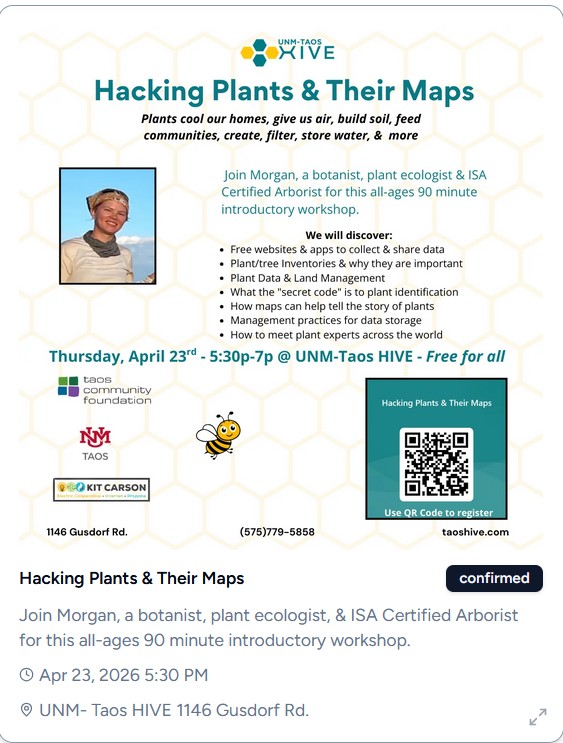
In celebration of the changing of seasons, we’re announcing a community presentation for all audiences.
UNM-Taos Hive is hosting our presentation on plants and technology in communities: Hacking Plants & Their Maps.
If you’ve ever wondered why plants are vital to your community, how to collect data and use that data to make management decisions, this is the community event for you.
We’ll be guiding attendees through the various free tools and resources that are available, tips and tricks to identifying problems in landscapes, and more.
This free presentation has limited seating, so register today to reserve your spot!
Ordinances from Policy to Practice@ 11:00am-12:30pm Mountain
Urban forest ordinances aren’t just technical paperwork—they’re the legal backbone that shapes planning, management, and long-term program success. Join UCFS for a dynamic workshop that demystifies ordinance language and gives you the tools you need to shape resilient, future-ready tree care policy.
Turning Problems into Prescriptions: Modern Tree Diagnostics @ 2:00pm-3:00pm Mountain
Learn how to properly identify and treat for issues by adding a diagnostic checklist to your PHC practice.
During this webinar, you will learn the most efficient way to implement a diagnostic checklist. Having a reliable template allows operators to efficiently sort through environmental factors, deliver a prescription and execute the necessary treatments. We will also cover the top urban tree insects for this season and how to control them using modern solutions.





 Abbott Botanical Assessments, LLC